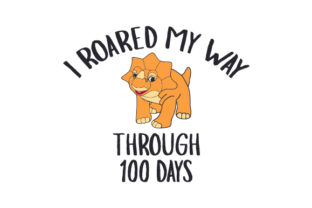
I Roared My Way Through 100 Days: A Stitch Test
First Impressions for the 100th Day Milestone
When evaluating a machine embroidery design intended for school milestones, my primary concern is always readability and emotional resonance. The "I Roared My Way Through 100 Days" concept immediately signals a celebration of resilience and achievement, specifically tailored for the 100th day of school. As a designer reviewing this asset for potential use in client projects or shop inventory, the first thing I assess is the visual hierarchy. Does the "100" stand out clearly from a distance? Is the lion or dinosaur motif (implied by "roared") integrated seamlessly with the typography, or does it feel like an afterthought?
This design falls squarely into the School Amp and Crafts categories, meaning it needs to bridge the gap between playful childhood aesthetics and clean, professional execution. For an Etsy seller or small shop product creator, this specific phrase targets a very narrow but high-intent niche. Parents and teachers are looking for this exact wording during a specific two-week window of the academic year. The mood is triumphant yet age-appropriate. When I look at the provided formats—SVG, Transparent PNG, EPS, and DXF—I see versatility for both digital cutting machines and sublimation, but as an embroidery specialist, I am mentally converting these vector lines into stitch paths. The success of this embroidery project will depend entirely on how well those bold, celebratory shapes translate into thread without becoming bulletproof or losing detail.
Real-World Application: The Custom Sweatshirt Test
To truly judge the viability of "I Roared My Way Through 100 Days," I envision a real-life production scenario: creating a custom crewneck sweatshirt for a kindergarten student. This is a classic custom apparel request that parents love to document on social media. In this context, the design serves as a centerpiece. I picture placing the artwork centered on the chest, approximately four inches wide.
In this scenario, the stitch density becomes critical. Sweatshirt fleece has a pile that can swallow fine details. If the "roar" text features jagged edges or tiny serif fonts, they risk getting lost in the fabric texture. As a reviewer, I would be checking if the design includes adequate underlay or if it requires me to add a topping stabilizer to ensure crisp lettering. The visual personality here should be bold and chunky. Thin, elegant scripts rarely work for a "roaring" theme. I want to see fill stitches that cover the fleece effectively without causing puckering, and satin stitch borders that are wide enough to prevent fraying after repeated washing. If the design relies heavily on running stitch outlines, I would advise testing on scrap fleece first, as those lines often disappear into the nap of the garment.
Furthermore, consider the color palette. A 100-day celebration often involves bright, primary colors or specific school mascots. Because we are working with a digital file that may need conversion for embroidery, verifying thread colors against the original artwork is essential. A vibrant orange lion might look muddy if stitched with a standard rust-colored thread. For a handmade product meant to be photographed for Instagram or an Etsy listing, high contrast between the thread and the sweatshirt base color is non-negotiable for visual appeal and buyer engagement.
Navigating Fabric Limitations and Hoop Constraints
While this design shines on stable knits, it requires careful handling on other substrates common in the Crafts category. If you plan to adapt "I Roared My Way Through 100 Days" for a tote bag design or canvas item, the lack of stretch makes stitching easier, but the coarse weave of canvas demands a different approach. You cannot rely on the fabric's give to accommodate dense areas. Using a cutaway stabilizer is mandatory here to prevent the design from distorting the bag’s shape.
Conversely, exercise extreme caution when applying this to baby items or thin cotton tees. The phrase "100 Days" implies a young child, but the design size might be too large or dense for delicate infant wear. If the digitization is heavy, it could create a stiff patch that is uncomfortable against skin or causes the lightweight fabric to sag. In these cases, resizing is not just about dimensions; it is about re-evaluating stitch density. You may need to reduce the fill percentage or switch complex fills to lighter tatami patterns to maintain the drape of the garment.
Dark fabrics present another challenge. If the provided files are primarily vectors intended for print, they may not account for the necessary white underlay required for embroidery on black or navy material. Without this base layer, dark fabric fibers can poke through lighter thread colors, making the "roar" look dirty or muted. Always run a test stitch-out on your darkest intended fabric before committing to a full production run for your craft business.
Commercial Viability and Professional Presentation
For creative entrepreneurs and apparel decorators, time is money. The inclusion of SVG, EPS, and DXF formats suggests this asset is versatile, but it also places the burden of proper digitizing on the maker. Unless you receive a specific digital embroidery file (like .DST or .PES), you are likely working with source art that must be converted. This distinction is vital for commercial embroidery professionals. Auto-digitizing software often struggles with the organic shapes of a roaring character and the precise spacing of milestone text.
If you are selling finished goods, the professionalism of your stitch-out directly impacts customer trust and perceived value. A jagged outline or misaligned text on a personalized gift screams amateur. Before listing any product featuring "I Roared My Way Through 100 Days," create printable mockups using the Transparent PNG to gauge market interest, but follow up immediately with a physical sample. Digital previews can be deceiving; they don't show sheen, texture, or tension issues.
Additionally, verify licensing. Just because you purchased the SVG or PNG bundle does not automatically grant commercial rights for machine embroidery reproduction. Clarify whether you can sell the physical embroidered items, the digital files, or both. This protects your shop from infringement claims and ensures ethical business practices. For Etsy sellers, unique presentation matters. Instead of just showing the flat design, photograph the finished product being worn or used. Show the back of the embroidery to demonstrate clean finishing. This transparency builds confidence with buyers who are investing in a milestone memory.
Designer’s Checklist Before Stitching
- Verify File Type: Confirm if you have a true embroidery file or a vector graphic requiring digitizing. Do not assume compatibility.
- Test on Target Fabric: Never stitch directly on a final garment without testing on a similar weight and texture scrap first.
- Check Small Details: Inspect the "100" numerals and facial features. If text is smaller than 0.25 inches, it may need to be enlarged or simplified to avoid thread breaks.
- Stabilizer Selection: Match your backing to the fabric stretch. Use tear-away for stable woven tote bags and cut-away for stretchy sweatshirts.
- Color Contrast Check: View the design in grayscale to ensure the "roar" elements remain distinct from the background without relying solely on color differentiation.
- Hoop Size Confirmation: Ensure the design fits your hoop with adequate margin for the presser foot. Crowding the hoop edges leads to registration errors.
- Wash Test: If producing for sale, wash and dry the sample to check for shrinkage or thread distortion before setting a price point.
Ultimately, "I Roared My Way Through 100 Days" is a high-potential asset for the seasonal market. Its success lies not in the digital file itself, but in the thoughtful translation of that file into thread. By respecting the technical limitations of embroidery and prioritizing real-world testing over digital perfection, you can turn this design into a best-selling staple for your handmade business.